Showing posts with label Napoleon. Show all posts

Tuesday, April 15, 2014

Is Nothing Sacred?!

Some of the loot stolen, including Boney's hair!
I was alerted to this story by La Petite Rosbif #1.

Don't they have any respect?! What is the world coming to, I ask you? The youth of today need more discipline, I tell you! When I was young...

Well, it seems more like it was a theft to order, as the nature of the items means they can't be flogged at the local pub for a knock down price without tipping off the fuzz.

Thursday, August 15, 2013

Wednesday, June 19, 2013

Boney Brou-ha-ha

Napoleon's still causing trouble, nearly 200 years after his loss at Waterloo saw him exit stage right!


Thursday, July 12, 2012

Guess Where I've Been?


I finally managed to get myself to this magnificent exhibition last night. With la petite Rosbifs at their grandmother's for the last few days of the school holidays, Madame Rosbif and I went to the National Gallery of Victoria here in Melbourne  for a bit of a date night and to absorb some French culture and history.

It certainly didn't disappoint! It covers the period from the last days of the Ancien Regime to Napoleon's exile to and death in St Helelna, with each period illustrated by paintings, etchings, period artefacts and video installations. Each room is devoted to one particular period such as the Revolution, Directory, Egypt campaign, Consulate etc, etc. with a wealth of objects and images illustrating each. 

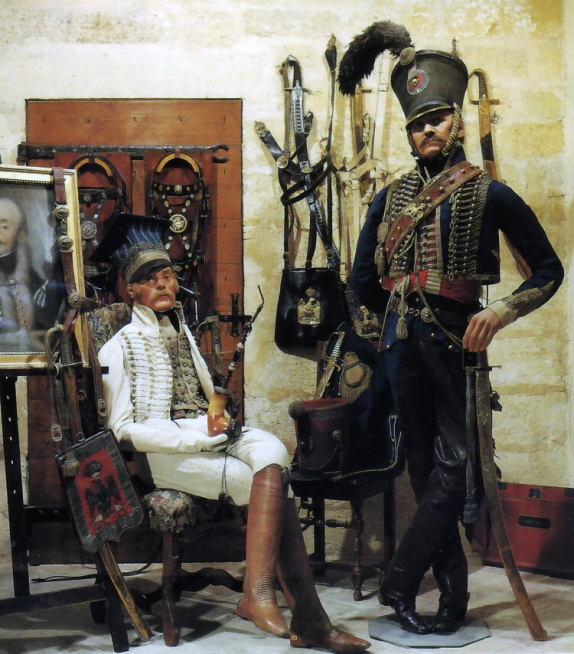
Obviously my favourites were the last couple of rooms which covered the Empire period from his coronation to his downfall. It holds a wealth of items from uniforms and weapons belonging to such luminaries Ney, Davout and Massena, to jewellery belonging to Joshephine, Hortense and Marie-Louise, Napoleon's travelling toiletries kit, Eugene's diamond encrusted signet ring etc. etc.

The chap on the right was included in the exhibition. Image from Musee de l'Emperi (Salon-de-Provence

Murat in all his tight pants glory! Painting by Gerard


If you're a Napoleonic buff here in Australia, or can afford a trip here, you can't miss this amazing collection of paintings and artefacts here all under the one roof at the same time. Come and see it while you can 

Below: Two short films from the exhibition website presented by the curator of Versaille


Thursday, February 16, 2012

WTF??!?

This was in today's online version of the Melbourne "Age".

I thought the French had more taste!

Thursday, November 24, 2011

Napoleon 1er cartes a jeuer

Only marginally relevant to this blog, but they are Napoleonic and they are for gaming, only not war-gaming!

My in-laws went to Europe a couple of years ago and made a special trip to the Waterloo battle-site especially to pick up some tourist tat for me. Included amongst the battlefield maps and guides, they bought me this pack of cards featuring famous portraits and battle scenes from the Napoleonic era.

The King, obviously, features pictures of the man himself, while the Queen features pictures of the women in his life, from his 2 wives to his mother and sister Pauline Borghese, and the Jacks are his Marshals and generals including Kleber, Davout, Ney and Murat. My favourites are the Jokers featuring Talleyrand and Fouche! The Aces feature battle scenes and the numbered cards feature important dates from the history of the 1er Empire.

My schoolboy French doesn't stretch to knowing what the symbols stand for, though; I guess 'R' stands for Roi, but 'D' (Dame?) and 'V' escape me! Maybe some of my Francophone readers could help?


Monday, November 15, 2010

Book review - Napoleon against himself ; a psycho-biography


I've just finished Napoleon Against Himself: A Psychobiography / Avner Falk. It's an interesting read ultimately let down by taking the argument too far, sloppy history and bad editing.

I've always been curious as to how and why Napoleon was so driven to become the most powerful individual in Europe from a relatively obscure background, and how this drive and utter self-belief that got him so far was ultimately responsible for his downfall. The author's argument boils down to lack of love from his mother from the earliest moment and an utterly self-consuming love-hate relationship with her that drove his narcissistic need for self-worth. Basically, the defendant conquered Europe because his mother didn't breast feed him, M'lud.

While it is true that an individual's earliest childhood days impact profoundly on the adult they become, the author goes to great lengths to spell out how each individual well-known episode in Napoleon's life was influenced by his need for his mother's love, which seemed to me to be stretching the argument. The analysis of his early life was interesting and I found quite convincing, but the further the author extrapolated the argument, the thinner it got. I always found it hard to understand how Napoleon was so fiercely proud of Corsica and how passionate he was for the cause of Corsican independence, but how easily he gave this up after Paoli and his followers rejected the Bonapartes and their politics. The author explains this in particular by theorising that Napoleon projected his love-hate relationship with his mother to his homeland and that Corsica became the 'bad mother' figure and France became the 'good mother' whereas previously the two positions had been reversed. The way his mother also had a strong, possibly sexual, relationship with French governor Marbeuf also explains why Napoleon's views towards France and his mother were so ambivalent and confused and how easily his loyalty could be transferred from one nation to another.

The reasons Napoleon's love-hate relationship with women in general, and Josephine in particular, also stands up to the argument put forward by the author; that is his unresolved love-hate relationship with his mother was the overriding template for all his relationships with the women closest to him. The sado-masochistic relationship with Josephine certainly was destructive, but because both parties enabled the other, was a co-dependent and almost symbiotic relationship.

However, when the author theorizes that Napoleon's underlying desire when erecting the triumphal pillar in the Place Vendome was to bolster his fragile ego by reassuring himself of his sexual potency by building a giant phallus, the author enters into
stereotypical la-la land Freudian arguments. Somehow, I can't imagine the author puffing on his pipe while Boney lies on the couch unburdening his deepest soul.

Also, when the author touches on aspects of Napoleonic history that I am most familiar with, he makes several howlers that stand out like dogs' whatsits. For instance, he claims that Murat was instrumental in persuading the Spanish royal family to abdicate in the favour of Joseph, when the truth is that Murat didn't have anything to do with the family squabbles of the Spanish Bourbons and that Carlos and Ferdinand both appealed to Napoleon of their own volition. Murat didn't have the Machiavellian skills or intelligence to involve himself at this level of politics. The author isn't even consistent in his arguments, saying that Marie-Louise abducted the King of Rome before the fall of Paris in 1814, then later conforming to the accepted view that under severe pressure from Joseph and other members of the government, she withdrew from Paris and waited for Napoleon's summons, which never came before the allies caught up with her. Which is it to be? Also, the author states that Napoleon delayed his departure for America after his defeat at Waterloo because he had an unconscious self-destructive desire to be caught, and that he could easily have taken ship and escaped. Later he claims that if he did, it would have been suicidal folly because the Royal Navy would have had no trouble stopping him. Again, which is it to be?

A book that had promise, but was let down by too much speculation and bad history. It could have been so much better.

Wednesday, April 28, 2010

Book review


I've just finished reading WATERLOO COMMANDERS: Napoleon, Wellington and Blucher by Andrew Uffindell (isbn 1844152499).

A good comparative biography of the three commanders of the Waterloo campaign. Having not a lot of knowledge about Blucher apart from his 1815 campaign, this was a good introduction to the man. It dispels the myth that he was just a tool of Gneisenau and that he was just a hussar who needed to be pointed in a particular direction. He was a great leader of men, much loved by his men and even by the Russian rank and file, with whom he cultivated a rapport with by such populist gestures as asking soldiers for tobacco for his pipe etc. He was able to motivate prickly subordinates like Yorck as well as Russian generals like Osten-Sacken. He could be impulsive at times, but his value as a commander was obvious when he was not available to command, ie. when he fell ill during the 1814 campaign in France, the Army of Silesia was rudderless. My favourite Blucher anecdote is his claim to be the only man in the world able to kiss his own head. So saying, he turned and gave Gneisenau a smack on the top of his head!

Uffindell's view of Wellington I didn't completely agree with; He argued that Wellington was not as prickly and controlling with his staff as legend portrays him. He was just picky about who he trusted and valued ie. his QMG Sir George Murray and his gaggle of young, well connected ADCs. What Uffindell failed to mention was that Wellington was still a creature of his age and that it didn't matter what your talents were, unless you came from the right background, you were very much on the outer, as with his intelligence chief Scovell (see The Man Who Broke Napoleon's Codes, Urban, M. isbn 0571205380 )who almost single-handedly ran Wellington's code-breaking and intelligence gathering operations, but remained at a relatively junior rank because of his background and lack of wealth and influence. His views on Wellington's logistical, tactical and strategic brilliance were pretty much spot on.

Napoleon on the other hand came in for a bit of a drubbing because of his lack of moderation in dealing with other nations, his accountability to no one and his belief in his own publicity, which are all fairly much accepted criticisms. Once his enemies united and fought him using his own methods, his fate was more or less sealed.

All in all a useful work that puts all three careers in perspective.
Related Posts Plugin for WordPress, Blogger...

My Shelfari Bookshelf